




P. Kolar, M. S. Grbić, S. Hrabar, Sensors 19, 03064 (2019)
M. S. Grbić, JAP 125, 224501 (2019)
T. Cvitanić, M. Lukas, M. S. Grbić, Rev. Sci. Instrum. 90, 043903 (2019)
D. Pelc, P. Popčević, M. Požek, M. Greven, and N. Barišić, Sci. Adv. 5, eaau4538 (2019)
D. Pelc, H.-J. Grafe, G. D. Gu, and M. Požek, Phys. Rev. B 95, 054508 (2017).
R. Blinder et al. Phys. Rev. B 95, 020404(R) (2017).
D. Pelc, M. Vučković, H.-J. Grafe, S.-H. Baek, M. Požek, Nature Communications 7, 12775 (2016).
D. Pelc, M. Požek, V. Despoja and D. K. Sunko, New J. Phys. 17, 083033 (2015).
M. Došlić, D. Pelc and M. Požek, Rev. Sci. Instrum 85, 073905 (2014).
T. Cvitanić, D. Pelc, M. Požek, E. Amit, and A. Keren, Phys. Rev. B 90, 054508 (2014).
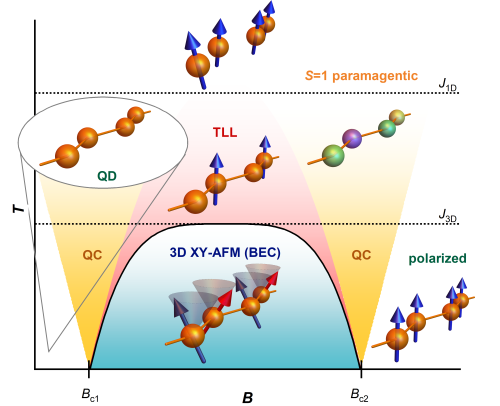
I. Jakovac and M. Grbić, together with collaborators from Japan, France and Germany, have succeeded to confirm theoretical predictions for the behavior of S=1 Haldane chain system in high magnetic field. These researchers have previously shown that the compound m-NO2PhBNO (abbreviation BoNO) is an ideal Haldane chain system, and this has now been confirmed by additional research. For the S=1 Haldane chain, it was predicted back in 2002 and 2003 that in a high magnetic field at temperatures lower than the intrachain interaction strength J1D, quasiparticles with attractive interactions appear (the so-called Tomonaga-Luttinger liquid (TLL)). At low temperatures, a magnetic Bose-Einstein condensate (BEC) of excitations (triplons) appears. The magnetic field plays the role of a chemical potential and, as it increases, creates more and more BEC bosons. The evolution of the TLL and BEC phases stops when the field reaches the value Bc2 = 4J1D + 8J3D when the quantum critical point (QCP) is reached and the entire system becomes polarized.
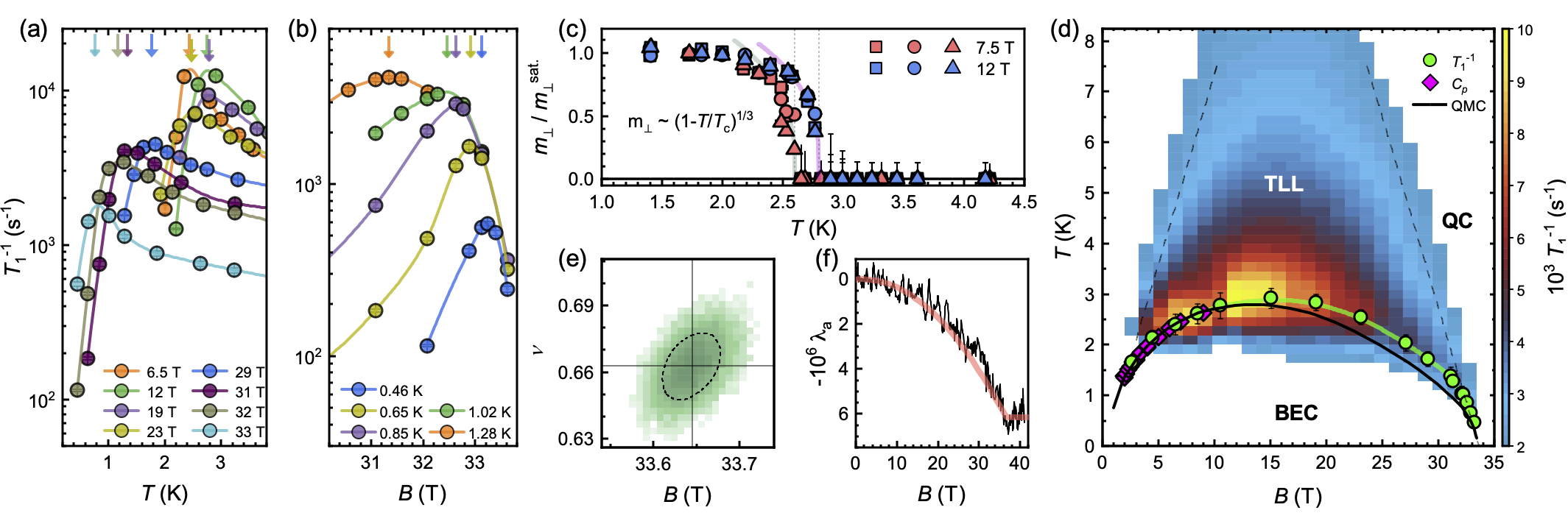
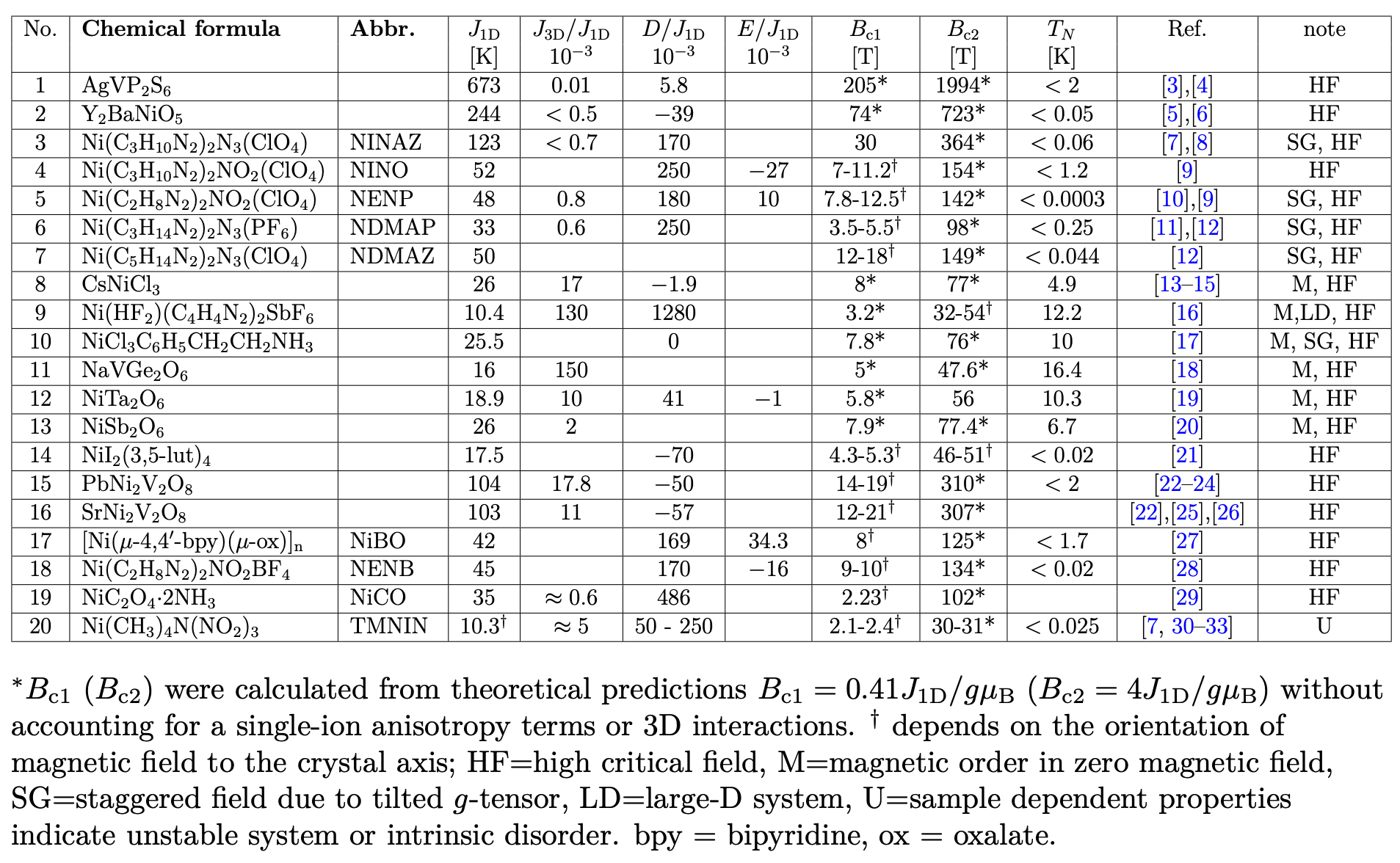
This discovery is particularly important because researchers have been creating new compounds of the Haldane system for decades in the attempt to demonstrate this behavior, and about 20 different compounds have been synthesized to date. All of them were based on transition metals and all of them have specific limitations related to anisotropy, which is why the predictions could not be confirmed. In contrast, BoNO was synthesized using a completely different approach - it is a fully organic compound without transition metal ions, which is why the anisotropy is extremely small. This is evidenced by the fact that the value of the electron g factor (2.0056 ± 0.0009) is extremely close to the free electron value (2.0023).
Paper has been accepted for publication in Physical Review Letters.
 Pristupačnost