


Researcher Dominik Cinčić from the Department and researchers Lavanya Kumar, Sibananda G. Dash, Maura Malinska and Mihails Arhangelskis (University of Warsaw, Poland) have published an article titled Experimentally Derived Charge Density of Halogen Bonds to Heavy Pnictogens: Revealing Electronic Structure and Validating Density Functional Theory Approaches in the prestigious Journal of the American Chemical Society (IF 15.6).
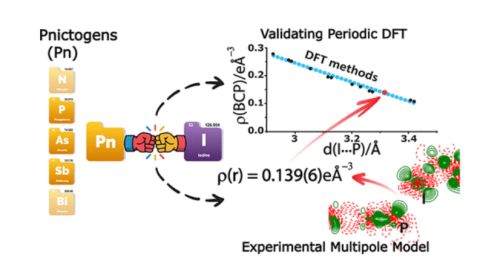
This work demonstrates a combined experimental and computational investigation of the electronic structure of the highly unusual type of halogen-bonded molecular crystals with phosphorus, arsenic and antimony atoms as halogen bond acceptors. Multipole refinement against high-resolution X-ray diffraction data shows the presence of bond critical points along the I···P, I···As, and I···Sb interaction paths, as well as clear nucleophilic and electrophilic features on the electrostatic potential surfaces, marking direct evidence for the bonding character of these interactions. The experimental results are then used as a benchmark for theoretical predictions obtained from a wide variety of density functional theory (DFT) methods, allowing a direct comparison of DFT-derived charge density distributions with experiment. It is shown that calculations with different DFT functionals result in widely different interaction geometries, energies, and charge density characteristics. The presented work demonstrates the value of experimental charge density analysis in benchmarking the computational methods for reliable prediction of the structural properties of halogen-bonded materials.
This research was performed as part of the project New building blocks for the supramolecular design of complex multi-component molecular crystals based on halogen bonds (HaloBond IP-2019-04-1868), financed by the Croatian Science Foundation.
 Pristupačnost