



 Pristupačnost










IP-2025-02-8238 CPepFunxIon
NAZIV PROJEKTA / PROJECT TITLE
Kompleksi ciklopeptida s funkcionalnim ionima
Cyclopeptide complexes with functional ions
Trajanje / Duration: 9.12.2025. – 8.12.2028.
Financiranje / Funding:
HRVATSKA ZAKLADA ZA ZNANOST

VODITELJ PROJEKTA / PRINCIPAL INVESTIGATOR: izv. prof. dr. sc. Gordan Horvat
PROJEKTNI TIM / PROJECT TEAM
PMF, Sveučilište u Zagrebu: Vladislav Tomišić, Matija Modrušan, Katarina Leko
Institut Ruđer Bošković: Antonija Tomić, Jiangyang You
Sveučilište u Milanu: Giovanna Speranza
Studenti/Students: Ana Jurčević, Paula Jukić
SAŽETAK
Razvoj anionskih receptora jedna je od ključnih tema supramolekulske kemije. U tom smislu, ciklopeptidi predstavljaju posebno zanimljivu klasu spojeva. Njihova sposobnost vezanja aniona proizlazi iz proton-donirajućih amidnih skupina, fleksibilnog makrocikličkog prstena i varijabilnosti peptidnih podjedinica.
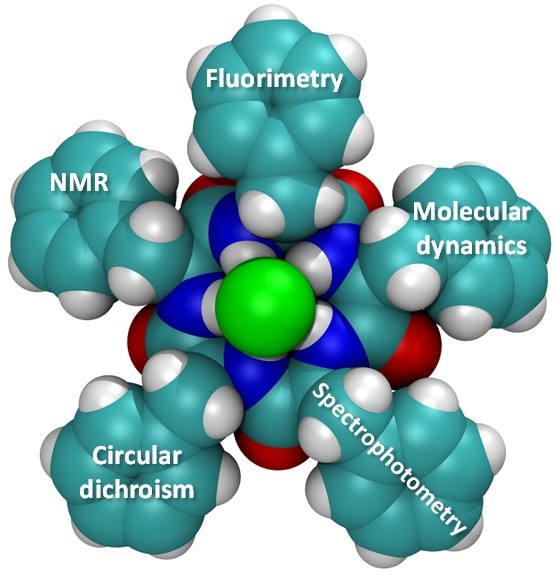
Ciljevi ovog projekta su vezani uz dizajn i sintezu ciklopeptida koji se sastoje od 4-6 aminokiselina i termodinamičku, spektroskopsku i strukturnu karakterizaciju njihovih kompleksa s funkcionalnim anionima koji posjeduju specifična svojstva. Ciklopeptidi koji će biti korišteni u istraživanju mogu se grupirati u četiri kategorije, ovisno o vrsti bočnih lanaca: alifatski, aromatski, hidrofilni i anion-koordinirajući. Funkcionalni anioni uključuju kolorimetrijske i fluorescentne boje, beta-laktamsku obitelj antibiotika i anionske radikale. Za karakterizaciju reakcija kompleksiranja bit će korišteno nekoliko eksperimentalnih metoda: izotermna titracijska kalorimetrija (ITC) te spektroskopije NMR, UV-Vis, EPR, CD i fluorimetrija. Računalna istraživanja bit će provedena pomoću simulacija molekulske dinamike i kvantno-kemijskih proračuna. Utjecaj solvatacije posebno će se istražiti izvođenjem eksperimenata u vodi i protičnim i aprotičnim organskim otapalima.
Očekuje se da će predložena istraživanja otvoriti nove mogućnosti u analitičkoj i medicinskoj uporabi proučavanih kompleksa, kao što su ciljana isporuka lijekova, povećanje stabilnosti i aktivnosti beta-laktamskih antibiotika i ekstrakcija aniona iz okoliša. Također, istraživani spojevi imaju potencijal za korištenje kao modelni sustavi za određivanje anionskih veznih mjesta u proteinima i proučavanju protein-protein interakcija.
ABSTRACT
The design and synthesis of anion receptors is a key topic in supramolecular chemistry. In that field, cyclopeptides represent a particularly interesting class of receptors. Their strong anion-binding properties arise from the proton-donating peptide groups, the flexible macrocyclic ring, and the variability of peptide subunits.
The goals of this project are related to the design and synthesis of cyclopeptides consisting of 4–6 amino acids, as well as the thermodynamic, spectroscopic, and structural characterization of their complexes with functional anions possessing specific properties. The cyclopeptides to be used in the research can be grouped into four categories based on the type of side chains: aliphatic, aromatic, hydrophilic, and anion-coordinating. Functional anions include colorimetric and fluorescent dyes, the beta-lactam family of antibiotics, and anionic radicals. Several experimental methods will be used to characterize the complexation reactions: Isothermal Titration Calorimetry (ITC), as well as NMR, UV-Vis, EPR, CD spectroscopies, and fluorimetry. Computational research will be conducted using molecular dynamics simulations and quantum-chemical calculations. The effect of solvation will be specifically investigated by performing experiments in water and both protic and aprotic organic solvents.
The proposed investigation will give rise to new possibilities in analytical and medical use of these complexes, such as target drug delivery, increase of stability and activity of beta-lactam antibiotics, determination of anion binding site in proteins, the detection of protein-protein interactions and for anion extraction from the environment. Also, the studied compounds could serve as model systems for the interaction of functional anions with larger peptides or proteins in living organisms.
PUBLIKACIJE / PUBLICATIONS
PRIOPĆENJA NA KONFERENCIJAMA / CONFERENCES